Front-End vs. Back-End: How Modern Web Apps Are Structured
by admin
| November 10, 2025
More than 1,200 apps and 15+ years of product work prove one thing: a beautiful interface alone does not make a product reliable. Real web apps depend on coordinated front-end and back-end engineering to deliver performance, integrations, and long-term business value.
What front-end and back-end actually do
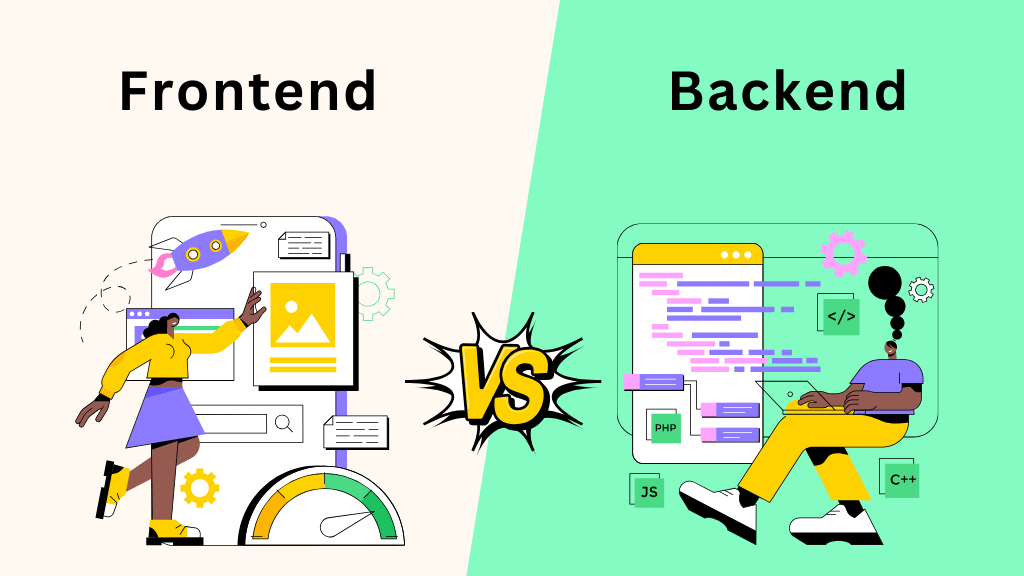
Imagine a web app as a restaurant. The front-end is the dining area with menus, seat arrangement, service flow and customers view. The back-end is the kitchen and supply chain recipes, order processing, inventory, security, and logistics. Both have to work efficiently for the dining experience to be perfect. Frontend tasks involve UI client-side state and accessibility backend tasks include data storage and business logics and integrations.
Why the split matters for product teams
By separating presentation from server logic experts can operate more efficiently and securely. Back-end developers create stable, versioned APIs for different clients (web, Android, iOS) while front-end designers need to UX and responsiveness.
API treated as a product (documentation, versioning, and security) allows teams to release UI tests without disrupting main tasks. Therefore, custom API development services are basic for multi-channel applications.
The technical responsibilities
Front-End
- Responsive designs and validations on the client side.
- Rendering that is accessible and great for SEO.
- Improvement of performance for perceiving speed.
Back-End
- Secure APIs with version control and the integration of third-party services.
- Data that is saved, caching and jobs scheduled.
- User verification, processing of payments, and compliance measures.
Where projects commonly fail
In a lot of cases teams consider front-end to be the product and put off back-end basics thus causing projects to come to halt. This practice leads to a very nice demo that does not work with real users or when an integration with the partner is needed. Among the common causes of failure are the lack of API contracts no maintenance plan and ineffective server-side logic all these problems need genuine PHP application development or equal backend engineering for solutions.
A practical, API-first framework
Start by designing the API contract and then move into UI sprint. Specify endpoints, authentication, error formats, and rate limits so that the front-end and back-end can work at the same time. Try out the user experience first and then strengthen the code later. Prototypes can be used to check UX, but don’t keep the throwaway code, instead have a maintainable front-end implementation.
Write backend ownership and maintenance into the project from the beginning. Consider including Application Maintenance Services and providing runbooks so that the application can adapt and last through real-world usage. Select the best stack for growth. For a lot of business systems, the php application development still is a sensible option for server-side logic and reliable hosting.
Real-world examples of responsibilities
The split between front-end and back-end duties in real-world development is very clear. For instance lets see an example in an e-commerce checkout flow the front-end deals with cart interactions and overall user experience whereas the back-end takes care of processing orders managing inventory calculating taxes and integrating with payment gateways through custom APIs and all of this is done without any API planning and maintenance leading to instant breaking of these flows.
This is similar with enterprise portals where interfacing with ERPs or CRMs requires powerful Custom api development services to maintain the correct and safe data exchange across systems. Further more in the case of modern Mobile + Web ecosystems the back-end APIs are the ones that allow Android, iOS, and web clients to be consistent hence the reason why teams frequently hire Android Developer or php developer to take care of platform-specific logic and long-term ownership. These instances underscore the point that structured back-end engineering is a crucial aspect of every user-facing experience.
Conclusion — Design both sides or pay later
The front-end attracts and the back-end maintains the product. The most clever projects consider APIs as major products allocate funds for Application Maintenance Services and choose the right backend development. This trio design integration and support is what distinguishes prototypes from production-quality web applications.



 Development Services
 Technologies
 ICO
ICO Consulting
 STO
STO  Cryptocurrency
 Exchange
  Blockchain
  CMS Development
 Framework Development
  E-Shop Development